Collision Avoidance and Navigational Assistance for Mobile Platforms
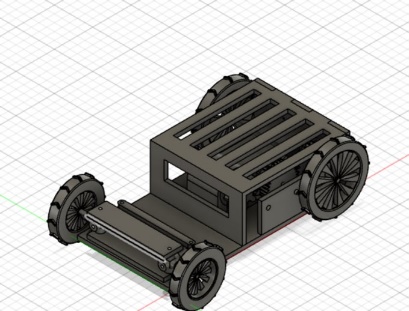
A four person university project to build a small driver assisted vehicle from scratch. I led the mechanical side: the gear reduction that lets it stop safely, the wheels, the chassis and the protective shell, all designed in CAD and made on 3D printers and a laser cutter.
Gear reduction cut the stopping time to under 2 seconds; unit costed at £450 with a 33% return
Four person team, two mechanical and two electrical. I was mechanical design lead.
- Under 2 s
- stopping time, achieved by gearing
- 230 × 120 mm
- final chassis after redesign
- £450
- retail price at 33.3% return
- 4
- person team, I led mechanical
Overview
The brief was a vehicle a person drives that steps in and stops itself before it hits something. That is the problem behind powered wheelchairs, warehouse trolleys and low speed assist vehicles, where the driver stays in charge but the machine has to intervene.
Rather than model it and leave it there, we built a working small scale vehicle. A hand held transmitter stands in for the driver, two ultrasonic sensors watch the path ahead and the electronics cut the motor when something gets too close. It also had to stand up as a product, with a price and a production route behind it.
What I did
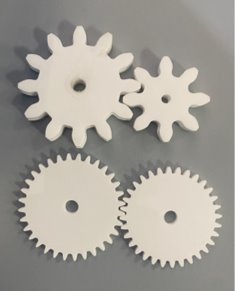
- Designed the gear reduction that makes the vehicle safe to stop, gearing the wheels down rather than adding a brake so it feels like a wheelchair, as the brief asked.
- Worked to a hard safety target of the wheels coming to rest within two seconds of the motor cutting, including the driver's own reaction delay.
- Redesigned the entire gear train when the supplied motor turned out to be a 6V unit at 1800 rpm, reworking it around the hardware we had instead of waiting on a new part.
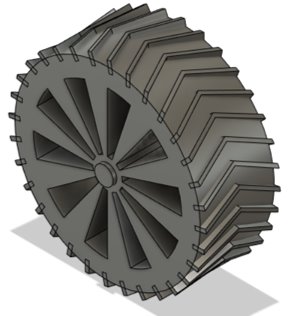
- Redesigned the wheels as a rim inside a tyre after the first version would not spin freely, adding a reinforcing ring once the spoked rim flexed under load.
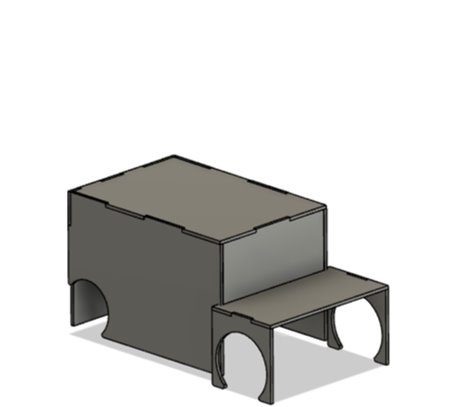
- Switched the shell from 3D printing to laser cut sheet within days when the print queue failed, reworking the geometry into flat panels to hit the demonstration date.
Methods
- CAD design of gears, chassis plates, wheels and shell, with tooth geometry set by module, count and bore
- Gear ratio selection to meet a two second stopping target rather than adding a mechanical brake
- FDM 3D printing in PLA and TPU, plus laser cutting of acrylic sheet
- Two HC-SR04 ultrasonic sensors, DS05-NFC steering servo, 40A speed controller, 2400 mAh battery, GT2E transmitter
- Physical testing on a built obstacle course, with design changes driven by what failed
- Cost modelling and material selection for a production version
Key results
- 01
The vehicle works, and stops inside the target. Test footage shows it driving under operator control, detecting an obstacle and stopping before contact, with the gear reduction bringing the wheels to rest inside two seconds.
- 02
Bonded acrylic is the wrong material for a loaded gear. The workshop only stocks 3 mm sheet, so each gear was two layers bonded into 6 mm, leaving a joint friction would work loose. Printed PLA gears replaced them.
- 03
TPU printing was too slow to rely on near a deadline. The tyre print took eight days and came out too soft to hold shape, so all four wheels shipped in PLA with one TPU tyre as a demonstration of intent.
- 04
The motor burned out on demonstration day. The wheels did not turn in front of the examiners, though the recorded testing shows the system working and a replacement motor is a swap rather than a redesign.
Outcome
The team took the project from a brief to a working vehicle we designed and built ourselves, with a price and a production route behind it. My side produced a drivetrain that stops safely by gearing rather than braking, wheels that roll properly, and a body that protects the electronics without blocking the sensors. The honest lessons are the useful part: material choice, print lead times and holding no spare for a single point of failure.